Two summers ago, I watched a couple lose $14,000 on their sale. Not because of the kitchen. Not because of the roof. Because the front of the house looked tired, and the buyer's agent used it as a wedge in negotiations before anyone had even walked through the door.
That's the thing about DIY curb appeal projects for selling your home — they're not decoration. They're negotiation leverage. And if you're selling in 2026, in a market where buyers have more choice than they've had in years, that leverage matters more than it did during the frenzy.
I've bought, renovated, and sold a handful of properties. I've also made every mistake in the book — including one $800 paint job I had to sand off entirely. What follows is what actually moved the needle, what wasted my time, and roughly what each project costs in real money and real hours.
Key Takeaways
- Buyers form an opinion in the first 8 seconds, before they leave the car. Everything you do outside is working against that clock.
- Power washing, door paint, and fresh mulch deliver the biggest visual change per dollar — often under $200 combined.
- Skip anything that reads as "a project in progress." Half-finished landscaping scares buyers more than bare landscaping.
- Budget your time, not just your money. Most of these projects take a weekend, not a month.
- Photograph your own house from the street before and after. If you can't see the improvement in a phone photo, neither will a buyer scrolling listings.
Why curb appeal decides your sale price before anyone steps inside
Here's a number that surprised me: exterior projects dominate the top of the resale value rankings, and a composite door replacement recovers a large share of its cost at sale. I'm not going to quote you a precise percentage from a report I can't verify — but the pattern is consistent enough that it's not really in dispute.
What matters more is the mechanism. A buyer arrives with a mental price tag already forming. If the exterior is sharp, they walk in expecting quality. If the exterior is rough, they walk in looking for problems. Same house, same interior, two completely different negotiations.
The eight-second rule
Pull up to any listing and time yourself. You'll form a verdict faster than you think. Sellers consistently underestimate this because they've lived with the house for years and stopped seeing it.
Which is why the first thing I do with any property is stand across the street and take a photo. Then I look at the photo, not the house. Photos are brutally honest in a way your eyes aren't.
What buyers notice first
In order: the driveway and walkway, the front door, the lawn edges, and the windows. Not the garden design. Not the fancy mailbox. The bones of the approach.
That ordering should drive your entire priority list.
Free DIY curb appeal projects that cost nothing but a Saturday
Before you spend a dollar, spend a day. I'll be honest — I skipped this step on my first flip and spent money on things nobody noticed while the driveway still looked like a construction site.
Declutter and depersonalize the exterior
Hoses, recycling bins, kids' toys, that stack of pavers you've been meaning to use since 2023. All of it reads as clutter in a listing photo. Store it, hide it, or get rid of it.
- Coil hoses and move them out of sight
- Relocate bins behind a fence or gate, not beside the garage
- Remove anything personalized — garden gnomes, team flags, novelty signs
- Clear cobwebs from the porch ceiling and light fixtures
- Edge the lawn along the walkway with a flat shovel (free, and it looks like you hired someone)
Clean everything that faces the street
Windows, door hardware, house numbers, light fixtures, the mailbox. A microfiber cloth and an hour will do more for perceived value than most purchases.
Sound familiar? It should. It's the least glamorous advice and the most effective. Clean beats decorated every single time.
The cheap projects that actually move the needle
Now we're spending money — but carefully. In my experience, the sweet spot for a pre-sale exterior refresh sits between $150 and $400 total. Above that, you're usually better off offering a credit and letting the buyer choose.
| Project | Typical cost | Time | Impact |
|---|---|---|---|
| Pressure wash driveway + walkway | $0–$80 (rental) or free if you own one | 2–3 hours | Very high |
| Repaint front door | $40–$70 | Half a day incl. drying | Very high |
| Fresh mulch, 3–4 cubic yards | $120–$200 | 3 hours | High |
| New house numbers + porch light | $60–$120 | 1 hour | Moderate |
| Replace worn doormat + planter | $50–$90 | 20 minutes | Moderate |
Pressure washing is the single best return
Concrete holds years of grime, and grime reads as age. When I pressure washed the driveway on a 1990s property I was preparing, the change was so dramatic I re-shot all the listing photos. The buyer mentioned the driveway in her offer letter.
Two warnings. Don't use a narrow nozzle on painted surfaces or wood siding — you'll strip the finish and create a repair job. And don't pressure wash a crumbling driveway. You'll make the cracks look worse, not better.
Paint the front door a color that commits
Beige doors disappear. A door in a deep, saturated color — navy, forest green, brick red — gives the eye somewhere to land. But it has to feel intentional, not accidental. Match it to a secondary color already present in the brick, roof, or shutters.
A mistake I made early on: I painted a door bright teal because I liked it. It clashed with the roof, and two buyers commented on it unprompted. Lesson learned. Pick a color that belongs to the house, not to your Pinterest board.
Landscaping without hiring anyone
Landscaping has the highest ceiling and the highest risk of looking unfinished. There's a sweet spot, and it's narrower than most sellers think.
The mulch-and-edge formula
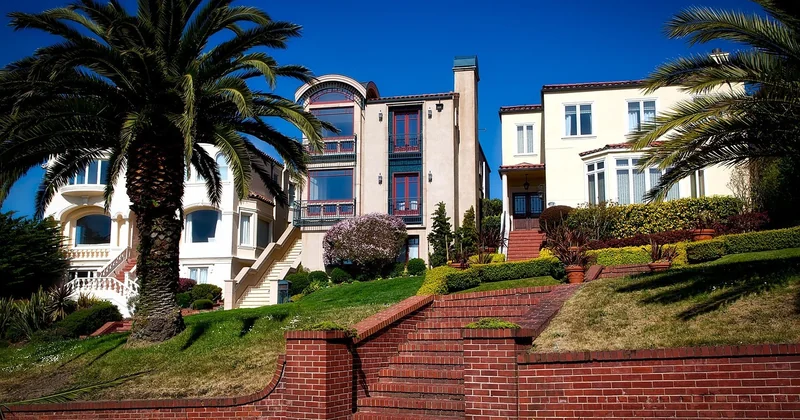
Fresh mulch plus a sharp edge along every bed instantly makes a yard look maintained. Choose one mulch color and use it everywhere. Mixed mulch — some dark, some light, some from last year — signals neglect.
For a small front yard, which is what most of us actually have, restraint wins. Three to five plant clusters, evenly spaced, in a coherent color palette. Not twelve different species competing for attention.
What to plant, and what to avoid
- Seasonal color near the entry — annuals in pots, changed out cheaply
- Shrubs that stay green year-round in your climate
- Anything that grows tall and blocks windows: avoid
- Plants that need daily water in peak summer: avoid, because you'll be busy moving
- Anything thorny near the walkway — buyers with kids notice
If your sale timeline is tight, container plants are the cheat code. You can move them, rearrange them, and take the good ones with you.
Driveway and walkway curb appeal ideas
The approach is the part of the property buyers physically traverse, and it's chronically overlooked. A few targeted fixes go a long way.
Fill cracks with a tube of concrete sealant — a $15 fix that stops the eye from snagging. Re-sand the joints between pavers. Trim any shrub or tree branch that overhangs the path, because overhanging branches read as "maintenance backlog."
Lighting deserves a mention here too. Solar path lights along the walkway cost under $50 for a set and photograph beautifully in dusk shots. If you're photographing in the evening — and you should try at least one — they matter.
What you should not do: resurface or replace the driveway before selling. It's expensive, disruptive, and buyers rarely discount as much for a worn driveway as the resurfacing costs. Patch, clean, and move on.
The projects you should skip
Not everything earns its keep. Here's what I'd leave alone.
- New fencing — costly, and taste-dependent
- Full lawn replacement — a buyer's dream yard may look nothing like yours
- Decorative water features — maintenance liability in most buyers' minds
- Anything requiring ongoing upkeep you won't be there to perform
The unifying logic: if a project's value depends on the buyer sharing your taste, it's a bet. Bet small.
Sequencing your projects before listing
Order matters more than most sellers realize, because some projects undo others. Pressure wash before you mulch. Paint the door before you photograph. Plant before you stage the porch.
I'd give yourself three weekends, minimum. One for cleaning and decluttering. One for the cosmetic fixes. One for landscaping and final touches. Then photograph on a bright, slightly overcast day — the light is softer and colors read truer than in harsh sun.
And here's the part nobody tells you: the projects that matter most are the ones a buyer can verify in a listing thumbnail. If it doesn't survive being shrunk to the size of a postage stamp on a phone screen, it's not doing any work for you.
So stand across the street tonight. Take the photo. See what the house is actually saying — because it's saying something, whether you meant it to or not.